An interview by @JuliaF1interviews_ . She does a great job of interviewing some of the interesting people behind the scenes in the Formula 1 paddock, including photographers, marshals and other performance coaches. There are thousands of people involved in the Formula 1 travelling circus, some who come along to every event, and others who are regulars at their local race. Take a look at some of her other interviews on her instagram page.
Can you introduce yourself? How long have you been doing this job and in F1?
Hi, my name is Paul Walker. I work with the teams in Formula 1 and have a particular speciality in improving pitstop performance. I worked the 2017 and 2018 seasons with Williams and the 2021 and 2022 seasons with Haas.
Can you describe a race weekend?
A race weekend for the guests is really cool. You arrive on a Saturday, maybe Friday if you really love the racing. You enjoy the sessions and the hospitality and you’ll be home in the evening after the race on a Sunday.
A race weekend for the teams is long and hard. Some team members arrive at the track as early as Monday to start setting up the garage. Once the garage is built, they will start building the cars Wednesday and Thursday, 12 hour days minimum. Friday the cars run, so you’re into managing the running of the cars and fixing any issues. There is usually a lot of changes Friday night, to get the car setup for P3 and qualifying on Saturday. Saturday is an easier day as the car goes into parc fermé after qualifying, so no changes can be made. Sunday is a long one. There is the prep for the race, then the race itself, but once that is over and the crowds head home, that’s when the pack-up starts. The cars will need to be stripped for travel and the garage is completely taken down. This is usually 6-8 hours of work after the race is over.
The term “race weekend” can have a slightly different meaning depending on who you talk to.
The hardest thing in this job?
The hardest thing changes all the time. Sometimes, it’s simply the time you spend away from your family. Sometimes, it’s managing all the different relationships you have at the track, when you’re looking after a team of 50 people and effectively living with them year round.
I’ve watched the guys at Haas work a full season in 2021, put in the same hours of work as everyone else, be away from their families just as long, the whole time knowing that there was almost no chance of getting points. A whole season with no reward and no hope. That was hard.
Then you contrast that with the start of the 2022 season, Kevin’s return and getting points in the very first race.
A difficult and brave decision by Guether in 2021 to not develop the car. The resilience of the team members to deal with that gruelling season. Both very hard, but that also led to the best moment with the team.
Which moment do you prefer or is your favourite moment during a race weekend and the opposite the worst moment?
My favourite moment is after the pitstop has been called, the guys collect the wheels and take their place in the pitlane. There’s usually about 8-10 seconds before the car arrives, but for that short period, time seems to slow down. It’s those few, brief, calm seconds before the pitstop where you can appreciate the work that you’ve put in over that week and the months previous.
Then conversely, the worst moment can literally be a few seconds later. The car pulls into the pit box and stops. You can hear the wheel guns not synchronised in their action. You can see something has gone wrong on one corner. The worst part is that short period where you know something has gone wrong, but you don’t know exactly what.
The first thought is “is everyone ok?” The pitstops are inherently dangerous and the last thing you want is someone be hurt. Then my head spins through everything we’ve done that week, whether there were any indicators from practice that something may go wrong on that corner, whether we have had any question marks on equipment, all the other potential issues. That moment of not knowing is the worst.
What do you remember from your experience in F1?
As cool as F1 may seem from the outside, it is still a job. You do the same tasks with the same people each week. You may be in another country, but the inside of a garage in Melbourne can look awfully like the inside of a garage in Imola.
The big moments, the ones that stand out and make it worthwhile are the good performances, like Kevin in Bahrain, or Lance taking a podium in Baku in 2017. But my personal favourite was when the Williams team won the F1 raft race in Montreal in 2018. A bit of friendly competition in the F1 paddock and good outcome for us. I think that was the only thing we won that year.
Can you present your new project?
Whilst having worked in elite sport my whole career often as a coach and manual therapist, I also have a PhD in Engineering. As a consultant, I feel I can make the biggest impact working at the intersection of human performance and technology.
I recently project managed “Swim 62”, a 2 day swimming event where we successfully supported the first person ever to swim around the island of Abu Dhabi. So from F1 to long-distance swimming, who knows what is next.
It has been a while since I last wrote a blog post, but when my friend Rob Pacey over at Sportsmith asked me to do a short article on the work that I do with Haas Formula 1 team, I thought it was a great opportunity. Here is the link to the full article:
Markus Rehm of just won the IPC World Championships in the Long Jump event. The big difference between his victory and all the other gold medals winners out in Doha, is that his performance would put him in the mix for medals at the able-bodied World Championships as well. This victory thrusts him into the world spotlight in a similar to Oscar Pistorius was back circa 2010, a headache that was just a German problem is now a world problem, should Markus Rehm be allowed to compete against the able-bodied athletes in major championships?
Markus has actually been peppering the 8.20m to 8.30m marks for a few years now, and last year had both the qualifying mark for the World Championships, and won the German National Championships, making him a prime candidate for automatic selection for the team. The Germans however didn’t select him, their exact reasoning is unknown to me, but contrary to current trends, the humble German Markus, did not pursue this in the courts. Each year he jumps further this becomes a more serious issue which needs to be resolved, this is no longer a one-off case of Oscar, now we have Markus, and we should expect more in the future. The big stand-out issue in the case of Markus is that he actually jumps off his prosthetic (as most amputee jumpers do). The fundamental argument is that why would you do that if it offered no advantage? And if it offers an advantage should it be allowed in able-bodied competition?
I once attended a talk by MIT professor Hugh Herr, a double amputee himself who works in engineering prosthetics and helped with research on the Oscar Pistorius case, who said that he sees the future of para-athletes as the fusion between engineering and humans, if the technology is allowed to continue progressing, disabled athletes in combination with their prosthetics, will be far surpassing the performances of the able-bodied athletes. Maybe this is beside the point, but ultimately my opinion is that these things definitely need to be treated more pro-actively, the rules and regulations need to be set and clarified before these situations arise. Any dispute at this point and the only person who will suffer is Markus himself. Any athlete knows that all you want to do is train and be allowed to compete, and you don’t want to have to be dealing with politics and court cases along the way.
Anyway, enough with the lengthy introduction, onto the interesting stuff, the maths.
The Long Jump Take-off
The long jump take-off is very simple, you are running down the runway as fast as you can, you now need to apply enough force in a very short period of time to raise your centre of mass in the air to travel as far as you can into a sandpit. You’re running, and then you jump. The take-off is a compromise between maintaining as much speed as you can from the run-up, which gives you forward speed in the air, and producing a vertical impulse to project you upwards. I call this a compromise because producing a higher vertical impulse will generally have a negative affect on forward velocity, so the compromise is finding the optimal amount for a particular athlete i.e. adding no vertical impulse and just running off the board is zero extra impulse but maintains speed the best, and it doesn’t result in a long jump.
Above, I have begun to use the term impulse, impulse in mechanics is the product of force and time and results in a change in momentum, in this case, the change in momentum being vertically. Sometimes you will see this written as:
Change in momentum = Impulse = Force x time
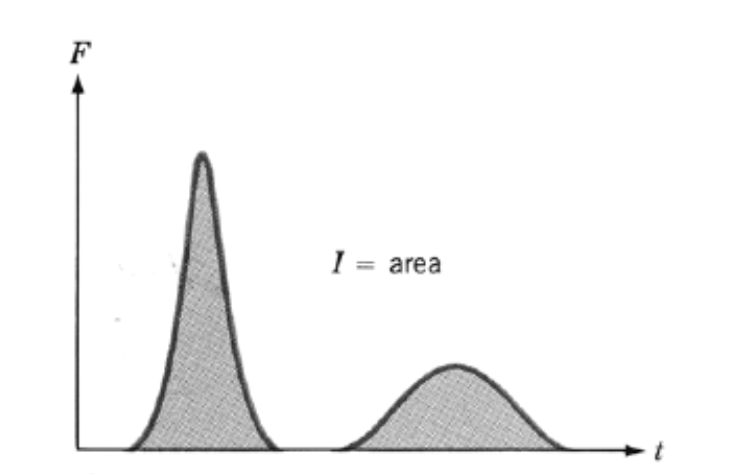
The vertical impulse at take-off is what determines the vertical projection and in conjunction with the run-up speed, the distance that is jumped. In real life, force and time factors are not set numbers that are multiplied, the force value will vary over the time, and will normally be drawn out as a force trace like so:
Therefore the impulse is actually equally to the area under this graph, the amount of force multiplied by each small time increment if you split the curve into a lot of very thin rectangles. In maths this process to find the area under the curve is integration.
So to increase the impulse, we can either increase the amount of force applied, or increase the time over which it is applied. Now we are going to look at how these two factors affect a long jumper, with either a leg or blade.
The Time factor
When long jumping on a leg, the time with which to apply force to the ground is inherently limited. Running fast on the runway requires relatively short ground contact times, so to increase these times for the last contact the hips are lowered slightly, this puts bend in the leg and allows a slightly longer period of time on the floor to apply force. However, the greater the hip and knee bend the greater the moment at these joints, a moment which is acting to collapse the leg.
A moment is force acting at a distance from a pivot.
Moment = force x distance from pivot
Therefore, if either the force, or the distance from the pivot increases, so does the moment. working to counter these collapsing forces is the work of the muscles in the leg. These muscles will have a fixed maximum force that they are capable of producing,(determined by athletes strength levels) and distance from the pivot (knee or hip joint) which is fixed by the muscle insertions. With both the force and the distance fixed, there is a set amount of resisting moment an athletes leg can produce. Lets call it M(max). Therefore, when the moment from the ground reaction forces gets greater than M(max), the leg will collapse and the athlete will not jump at take-off. For simplicity sake we will keep the forces involved the same and just change the bend in the leg, see the below diagram to see how this affects the moment arm:
Diagram 2: showing effect of knee flexion on moment arm
Therefore, for a given athlete, there is only a certain amount of knee bend which can achieved at take-off before collapse, and so the contact time is limited is limited by this.
When a prosthetic blade is introduced for a below the knee amputee, what you introduce is another mechanism for deformation. There is still give at the hip and the knee, but now there is the bending of the carbon blade as well, so without increasing the collapsing moment on the leg this additional bending will actually increase the amount of time the athlete is on the floor for, giving them the chance to apply a greater impulse.
Influencing Force Application
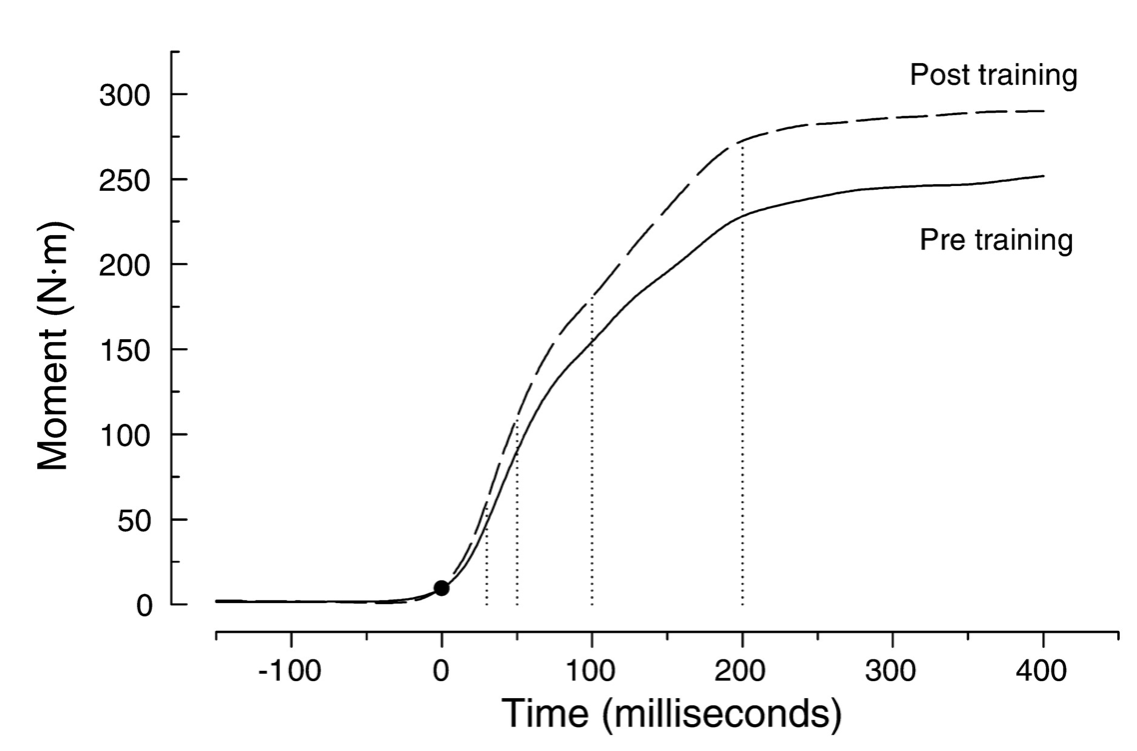
Interestingly the contact time not only increases the impulse directly, but also increases the ability of a muscle to apply force and thus increase the impulse indirectly as well. See this graph on rate of force development (RFD) in a muscle:
Diagram 3: This diagram shows rate of force development in the gastrocnemius muscle pre and post training, but basically shows the trend we’re looking for, low ability to produce force in short time frames, with a steep increase and then it flattens out (borrowed from http://www.noyodecia.com/journal-of-applied-physiology.html)
The contact times in sprinting and jumping are so short that we can actually produce only very small amounts of muscular force. These contacts times are short and so are on the steep part of the curve near the left, therefore any small increase in the contact times (perhaps facilitated by increased deformation of a carbon blade) will dramatically increase the amount of muscular force allowed to develop. This greater muscular force can then feed back into the earlier equation and increase M(max) and allow a slightly deeper hip and knee bend as well, increasing the contact time for double benefits. In the body this is one of the roles of tendons, to delay the onset of peak force, which gives the muscles more time to contract and reach a higher peak force to handle the load, now you have an athletes tendons, plus the carbon blade working towards this same goal.
The other major influence on force production is that because of the extra theoretical degree of deformation of the leg overall on a para-athlete, there is the possibility that this would allow a different technique for take-off. A technique that may put the body in a better position to apply force to the board without increasing the torque at the hip and knee, hitting the board with a straighter alignment and using the carbon to absorb energy and return it on take-off, a theoretical further advantage which would need to be studied further. A greater ability to apply force may result in greater deformation of the blade and thus a higher contact time again.
Long Term Effects
All of these factors will also have an affect on how an athlete can train long-term. Long Jump athletes will be limited by how many jumps they can do in training due to risk of injury. Its very difficult to pin down a specific cause of injury, but a big concern must be the high peak forces transmitted through the leg at take-off, a short impulse time necessitating higher forces to produce an adequate impulse for jumping. Even if the blade only increases contact time and doesn’t allow greater application of force, the lower peak forces overall could allow a greater volume of jumps to be performed in training, a greater training affect leading to an advantage? This argument gets a bit too theoretical so I’m going to try and steer clear now.
There must be downsides
Just remember this is all theoretical, but so far, with a carbon blade we can increase the contact time, which allows us to increase the force applied, which could then increase the contact time further. It all seems up (a subtle pun on the jumping direction) to me so far, so I will also try and provide some balance. There are multiple downsides.
First compare the world record for the amputee 100m to Usain Bolt (not entirely scientific, but acceptable for a blog post) 10.57 for double leg amputee Alan Oliveira of Brazil versus 9.58 for the able-bodies Bolt. It would appear that his ability to reach a higher runway velocity would be limited due to the prosthetic, and higher runway speeds being correlated with longer jumps, this would be a disadvantage.
However, although this is a disadvantage, the fact that he still manages to jump as far as Greg may provide further evidence that the blade is providing a competitive advantage. Maybe….
Similarly, and I hope not to come across as to patronising here, but the lack of a lower limb will affect other areas of training and of life. There will certain exercises which will be difficult, or even impossible with a prosthetic that other jumpers may consider very important. Even exercises lifting weights will need to be adapted or changed. Too much impact can cause problems at the interface between prosthetic and limb. The prosthetics used for every day life are far less efficient than when walking with two legs, so its actually metabolically more costly to do any every day task for him. The problem becomes what advantages and disadvantages should you be weighing up to decide if it is fair to compete? Athletics ultimately is the epitome of unfair, otherwise everyone would jump the same distance and cross the finish line together, I don’t know if this is an argument for or against his participation.
Advantage or no
Throughout this whole discussion, there is no way to actually prove beyond reasonable doubt whether there is an advantage or not. We can prove that it is different, but does different mean better or worse, no one knows. The question becomes should different be allowed? If allowed, can able bodies athletes start adding Carbon blades under their feet for some of these theoretical advantages? If so, you then change the physiological and technical requirements of the event and actually a person who may have used to be mediocre could become the best in the world because their physical traits didn’t quite match up with the old event but do with the new one. There is a lot to think about and it becomes more of a philosophical debate.
Lie I said at at the start the only person this negatively affects is Markus really. This contentious issue should have been dealt with more completely the first time around and hopefully it can be cleaned up more thoroughly now.